
Microsoft Teams voicemail transcription is moving to Azure LLM Speech. This update should improve transcription accuracy, speed up processing, enhance reliability, and add automatic language detection for 14 additional languages.
This update does not change any existing voicemail policies in Teams.
Timeline
The rollout should be completed by late July 2026.
How does this affect your organization?
This update affects every organization using Microsoft Teams voicemail transcription, including transcripts delivered through Exchange Online. The underlying engine automatically switches to the Fast Transcription API, now provided by Azure LLM Speech.
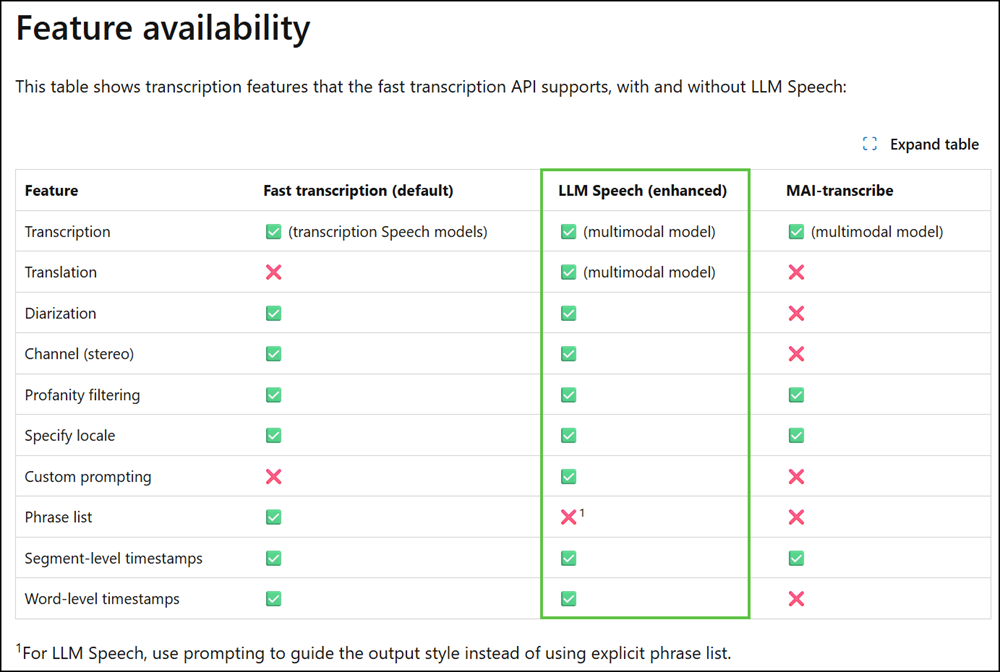
- Organizations do not need to take any action for the migration itself, and existing voicemail policies carry over unchanged.
- Once moved, the service should detect the spoken language automatically before generating a transcript, rather than relying solely on a preset language.
- There are no changes to voicemail storage or compliance controls. The underlying processing flow remains unchanged; only the transcription LLM model is being upgraded.
- Better transcripts should also strengthen what Microsoft 365 Copilot can do with voicemail, since it can draw on richer transcript content. Microsoft is working separately to have Copilot recognize voicemail as its own message type within the next few months.
Voicemail transcription currently covers 9 languages:
English, Spanish, Portuguese, French, German, Italian, Dutch, Chinese, and Japanese.
This update also adds 14 additional languages, so more users can receive translated voicemail transcription after the change is implemented, provided voicemail transcription is enabled via a Teams Voicemail policy.
- Arabic (ar-SA)
- Czech (cs-CZ)
- Danish (da-DK)
- Finnish (fi-FI)
- Hebrew (he-IL)
- Hindi (hi-IN)
- Hungarian (hu-HU)
- Korean (ko-KR)
- Norwegian Bokmål (nb-NO)
- Polish (pl-PL)
- Russian (ru-RU)
- Swedish (sv-SE)
- Thai (th-TH)
- Turkish (tr-TR)
The new languages are enabled by default for tenants who already have voicemail transcription enabled.
Cloud Voicemail translates the detected language into either the user’s preferred language or the default tenant language, in priority order. Administrators should check the table of supported voicemail transcription languages to confirm whether the user’s preferred language code is supported.
To review your current setup, voicemail transcription is configured in the Teams Voicemail policy. Via PowerShell, administrators can review the two properties EnableTranscription and EnableTranscriptionTranslation.
EnableTranscription
Allows you to disable or enable voicemail transcription. Possible values are $true or $false.
EnableTranscriptionTranslation
Allows you to disable or enable translation for the voicemail transcriptions. Possible values are $true or $false.