
The Interpreter agent in Teams is getting a new consecutive interpretation mode that enables turn-based speech-to-speech translation in two-language meetings.
Compared to before, the Interpreter agent now has two different modes, which is also important for those who need a Microsoft 365 Copilot license:
- Simultaneous interpretation mode (introduced in 2025), suited for broadcast events with simultaneous audio translation in near real-time. Users need a Microsoft 365 Copilot license to use the simultaneous interpretation mode.
- Consecutive interpretation mode (new, in Public Preview), suited for interactive, two-way conversations across a language pair, supported on Teams for Windows, Mac, and Web. Only the meeting organizer needs the Microsoft 365 Copilot license.
20 hours of interpretation are included per person per month with a Microsoft 365 Copilot license. Access beyond the included hours is subject to available capacity.
Timeline
- Public Preview is available for meeting organizers in Teams Public Preview with a Microsoft 365 Copilot license.
General availability is scheduled for June 2026.
Updated 14 July 2026:
Microsoft has paused the rollout at this time.
How does this affect your meeting organizers?
The Interpreter agent in Teams previously supported only simultaneous interpretation, introduced in 2025. Consecutive interpretation is a new, separate mode now available alongside it.
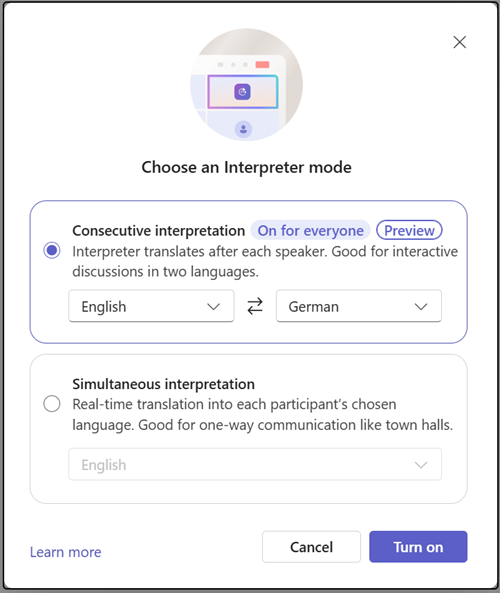
With consecutive interpretation, translation starts after each speaker finishes, creating a turn-based flow suited to interactive, two-way conversations across a language pair. The Interpreter agent is brought onto the meeting stage so all participants can see and hear the translation. A Copilot Premium license is not required for the participants.
Only the meeting organizer can enable the Interpreter agent in the consecutive interpretation mode. Once active, all meeting participants automatically see and hear the interpreter on the meeting stage, with no per-user configuration required.
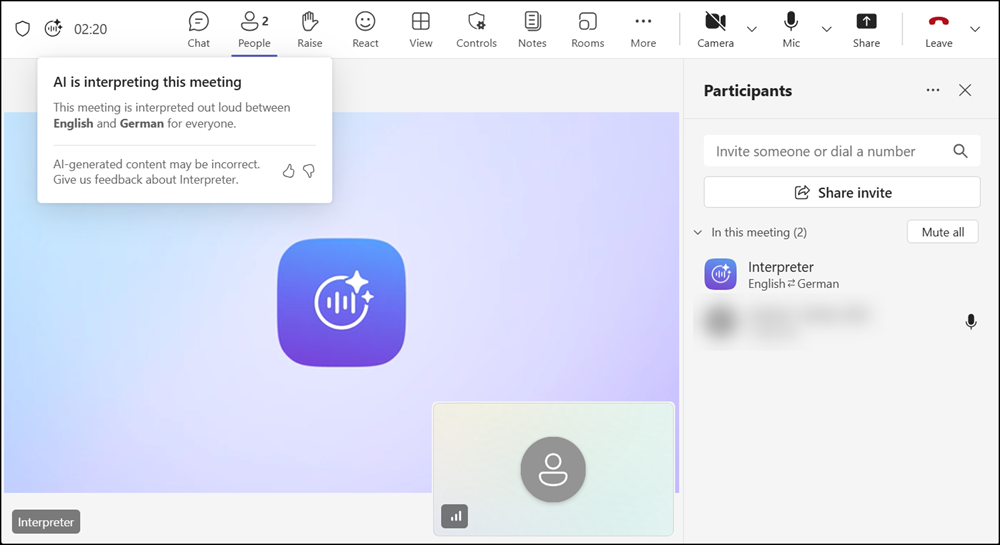
Consecutive interpretation mode supports any language pair drawn from the following languages:
Chinese (Simplified), Chinese (Traditional), English, French, German, Italian, Japanese, Korean, Portuguese, and Spanish.